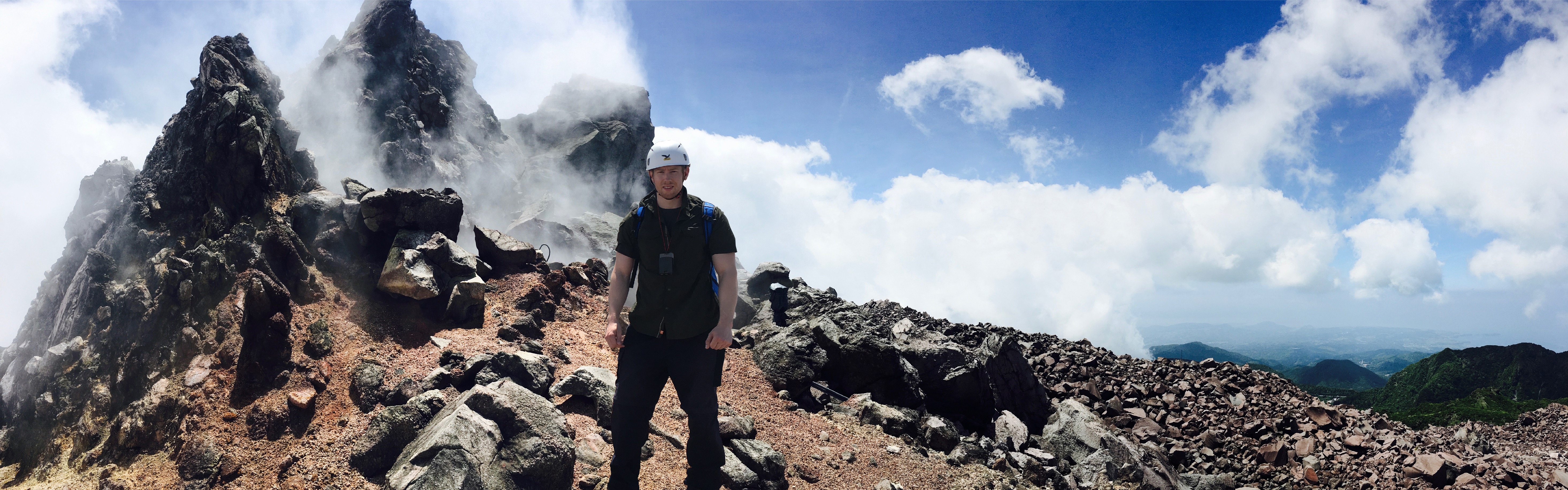
DR PAUL WALLACE
ASSISTANT PROFESSOR OF VOLCANOLOGY
Experimental Volcanology | Igneous Petrology | Magma Rheology
Dynamics of Lava Dome Eruptions
Lava dome eruptions involve slow extrusion of viscous, crystal-rich magma that builds spines and domes lasting months to decades. Eruption style is controlled by how efficiently gases escape through a shallow conduit: connected pores and fractures promote degassing and steady effusion, while sealing by compaction or healing traps gas, raises pressure, and can trigger explosive fragmentation. Localised shear zones and faults can either open pathways or act as barriers, driving rapid shifts between quiet extrusion and ash-rich explosions. Because these processes occur near the surface, integrated monitoring (deformation, seismicity, gas, thermal) is essential. My research links crystal-scale deformation to shear-zone permeability, improving understanding of sealing–venting cycles and forecasts of eruption-style changes.
Selected Publications
Wallace, P. A., Kendrick, J. E., Miwa, T., Ashworth, J. D., Coats, R., Utley, J. E. P., Henton De Angelis, S., Mariani, E., Biggin, A., Kendrick, R., Nakada, S., Matsushima, T., & Lavallée, Y. (2019). Petrological architecture of a magmatic shear zone: A multidisciplinary investigation of strain localisation during magma ascent at Unzen Volcano, Japan. Journal of Petrology, 60(4), 791–826. https://doi.org/10.1093/petrology/egz016
Wallace, P. A., Lamb, O. D., De Angelis, S., Kendrick, J. E., Hornby, A. J., Díaz-Moreno, A., González, P. J., von Aulock, F. W., Lamur, A., Utley, J. E. P., Rietbrock, A., Chigna, G., & Lavallée, Y. (2020). Integrated constraints on explosive eruption intensification at Santiaguito dome complex, Guatemala. Earth and Planetary Science Letters, 536, 116139. https://doi.org/10.1016/j.epsl.2020.116139
Lavallée, Y., Miwa, T., Ashworth, J.D., Wallace, P.A., Kendrick, J.E., Coats, R., Lamur, A., Hornby, A., Hess, K.-U., Matsushima, T., Nakada, S., Shimizu, H., Ruthensteiner, B., and Tuffen, H. (2022). Transient conduit permeability controlled by a shift between compactant shear and dilatant rupture at Unzen volcano (Japan). Solid Earth. https://doi.org/10.5194/se-13-875-2022
Lamb, O.D., Lamur, A., Díaz-Moreno, A., De Angelis, A., Hornby, A., von Aulock, F.W., Kendrick, J.E., Wallace, P.A., Rietbrock, A., Alvarez, A., Chigna, G., Lavallée, Y. (2019). Disruption of long-term effusive-explosive activity at Santiaguito, Guatemala. Frontiers in Earth Science. https://doi.org/10.3389/feart.2018.00253
Pre-eruptive Hydrous Mineral Stability
Hydrous minerals such as amphibole are key phases in intermediate–silicic magmas and sensitive recorders of pre-eruptive conditions. Their stability depends on pressure, temperature, melt composition, dissolved volatiles, and redox state. During ascent or heating, amphibole commonly breaks down into reaction rims of pyroxene, plagioclase, and Fe–Ti oxides, preserving evidence for changes in storage depth, thermal input, volatile budget, and oxygen fugacity. CO₂-rich fluids can rapidly destabilise amphibole by lowering water activity, while more oxidising conditions shift equilibria toward Fe³⁺-rich assemblages. Rim thickness, textures, crystallography, and mineral chemistry together encode these coupled histories, especially when paired with melt and volatile data. Our research uses amphibole rims to quantify pre-eruptive timescales and volatile–redox changes.

Selected Publications
Wallace, P. A., De Angelis, S. H., Larsen, J., Caricchi, L., Kendrick, J. E., & Lavallée, Y. (2025). CO2 flushing and redox as drivers of pre-eruptive amphibole breakdown. Earth and Planetary Science Letters, 667, 119532. https://doi.org/10.1016/j.epsl.2025.119532
Explosive Volcanism in the East African Rift
Explosive eruptions in the East African Rift are fueled by volatile-rich, often peralkaline rhyolite–trachyte magmas stored in complex caldera systems. Because long repose periods limit historical records, robust risk assessment relies on tephrostratigraphy combined with modern monitoring (seismicity, deformation, gas, thermal). In the Kenya Rift, the Olkaria–Longonot–Suswa–Menengai caldera cluster records repeated explosive phases interspersed with dome growth and geothermal activity. In the Ethiopian Rift, peralkaline centres preserve widespread tephras and episodes of recent unrest, highlighting transitions between hydrothermal and magmatic activity. Our research combines tephrostratigraphic frameworks with petrological and geochemical models to refine source attribution and eruption chronologies, strengthen monitoring strategies and long-term hazard assessments, and support future geothermal development.

Selected Publications
Wallace, P. A., Otieno, V., Godec, P., Njoroge, R. W., Tubula, M. S., Cappelli, L., Kamau, P. M., Nomade, S., Mariita, N. O., & Fontijn, K. (2025). Temporal and spatial evolution of explosive silicic peralkaline eruptions at the Olkaria Volcanic Complex and Longonot volcano in the Southern Kenya Rift. Journal of Volcanology and Geothermal Research, 460, 108275. https://doi.org/10.1016/j.jvolgeores.2025.108275
Tadesse, A. Z., Fontijn, K., Wallace, P. A., Gurioli, L., Laha, P., Terryn, H., & Ayalew, D. (2024). Eruption style and dynamics of the ~87 ka Baricha peralkaline rhyolite eruption in Ethiopia. Bulletin of Volcanology, 86, 93. https://doi.org/10.1007/s00445-024-01787-9
Volatile Budgets and Degassing in Rift Zones
Continental rifts are major sources of deep CO₂ and other magmatic gases because long-lived faults and shallow magmatic–hydrothermal systems provide efficient pathways to the surface. Much of this degassing is diffuse, through soils, steaming grounds, and fractured terrain, so it requires dense ground-flux surveys paired with isotopic source tracing. Fault architecture strongly controls emissions: normal faults and ring fractures focus flow into narrow corridors that can sum to large, system-scale fluxes. Melt inclusions show rift magmas (alkaline to peralkaline) are volatile-rich but often stored shallow and variably undersaturated, so ascent processes govern gas–melt decoupling. Our research combines structure-based flux mapping with petrologic volatile inventories to improve rift-scale volatile budgets and hazard assessment.

Selected Publications
Cappelli, L., Wallace, P. A., Ernst, G. G. J., Mbede, E., Kwelwa, S., Abdallah, E., & Fontijn, K. (2025). Pre-eruptive reservoir conditions of the peralkaline Rungwe Pumice Plinian eruption (Tanzania) from haüyne-hosted melt inclusions. Journal of Petrology, 66, egaf079. https://doi.org/10.1093/petrology/egaf079
Cappelli, L, Wallace, P.A., Randazzo, A. et al. (2023). Diffuse soil CO2 emissions at rift volcanoes: Structural controls and total budget of the Olkaria Volcanic Complex (Kenya) case study. Journal of Volcanology and Geothermal Research. https://doi.org/10.1016/j.jvolgeores.2023.107929
Magma Rheology and Crystal Deformation
Magma is a multiphase fluid whose flow behavior changes dramatically as it cools, crystallises, and degasses. Temperature, composition, volatiles, and the size and shape of crystals and bubbles determine whether deformation is distributed, localised into shear bands, or ends in brittle failure. As crystal frameworks grow, magma becomes stronger and increasingly strain-rate and history dependent, and crystals record this stress through reorientation, intracrystalline plastic deformation and/or microfracturing. These microstructures and crystal/microlite fabrics preserve a record of ascent conditions. Our research uses high-resolution EBSD to quantify crystal-scale deformation and couples these data with rheological models to link microstructure to evolving viscosity and failure thresholds assessment.

Selected Publications
Wallace, P. A., Kendrick, J. E., Miwa, T., Ashworth, J. D., Coats, R., Utley, J. E. P., Henton De Angelis, S., Mariani, E., Biggin, A., Kendrick, R., Nakada, S., Matsushima, T., & Lavallée, Y. (2019). Petrological architecture of a magmatic shear zone: A multidisciplinary investigation of strain localisation during magma ascent at Unzen Volcano, Japan. Journal of Petrology, 60(4), 791–826. https://doi.org/10.1093/petrology/egz016
Coats, R., Kendrick, J. E., Wallace, P. A., Miwa, T., Hornby, A. J., Ashworth, J. D., Matsushima, T., & Lavallée, Y. (2018). Failure criteria for porous dome rocks and lavas: A study of Mt. Unzen, Japan. Solid Earth, 9, 1299–1328. https://doi.org/10.5194/se-9-1299-2018
Faulting in Volcanic Environments
Faulting is widespread in volcanic systems, from conduit walls and dome margins to caldera ring faults and landslide detachments, and can localise strain enough to generate short-lived frictional melts that quench as pseudotachylytes. Early melting preferentially consumes low-temperature phases and interstitial glass, shaping melt chemistry; continued slip entrains fragments to form a crystal-bearing suspension. Its composition, temperature, and crystal fraction control viscosity and shear resistance, so the melt can either lubricate slip or act as a viscous brake. Pseudotachylyte glass, microlites, and geochemical fingerprints preserve slip rate, localisation, and thermal history. Our research links the chemistry and rheology of these melts to the conditions of volcanic faulting.

Selected Publications
Wallace, P. A., Kendrick, J. E., Miwa, T., Ashworth, J. D., Coats, R., Utley, J. E. P., Henton De Angelis, S., Mariani, E., Biggin, A., Kendrick, R., Nakada, S., Matsushima, T., & Lavallée, Y. (2019). Petrological architecture of a magmatic shear zone: A multidisciplinary investigation of strain localisation during magma ascent at Unzen Volcano, Japan. Journal of Petrology, 60(4), 791–826. https://doi.org/10.1093/petrology/egz016
Coats, R., Kendrick, J. E., Wallace, P. A., Miwa, T., Hornby, A. J., Ashworth, J. D., Matsushima, T., & Lavallée, Y. (2018). Failure criteria for porous dome rocks and lavas: A study of Mt. Unzen, Japan. Solid Earth, 9, 1299–1328. https://doi.org/10.5194/se-9-1299-2018
 Paul A. Wallace